Адреса:
7, Стецьківська вул., місто Суми, Сумська область, 40491, Україна
Адреса:
7, Стецьківська вул., місто Суми, Сумська область, 40491, Україна
Ideas shaping Ukraine’s future
Ideas shaping Ukraine’s future
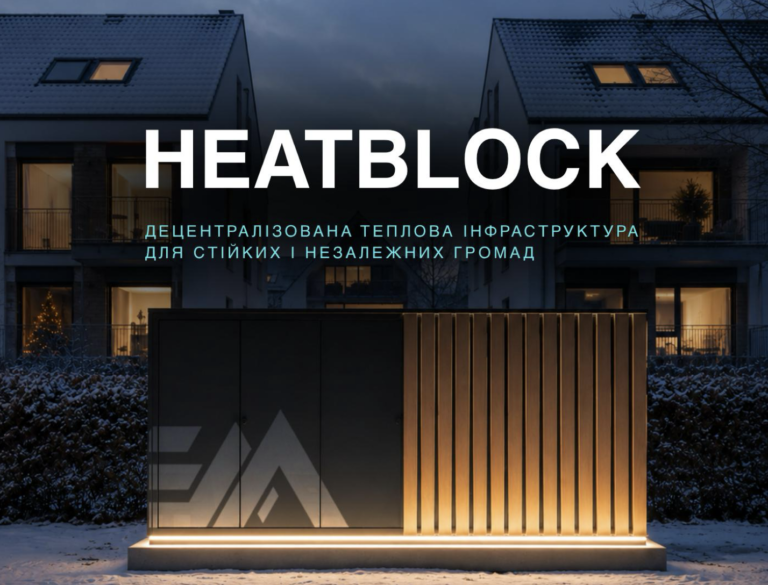
Heating is undergoing a systemic transformation. The next generation of thermal infrastructure will be less dependent on fossil fuels, more localized, electrified, automated, and integrated with renewable energy sources.
For Ukraine, this transformation is part of reconstruction and the transition from vulnerable centralized infrastructure to distributed local systems. For Europe, it is part of the long-term transition toward decarbonized, energy-efficient, and intelligently managed heating.
HEATBLOCK — a new energy reality
HEATBLOCK is a serially manufactured, factory-ready thermal energy station based on high-efficiency heat pumps, transferring the majority of engineering, assembly, automation, and testing from the construction site to the manufacturing facility. The result is a standardized energy module delivered to the site at a high degree of readiness, connected to the thermal and electrical infrastructure, and scalable from a single building to a residential district, municipal complex, or industrial site.
The manufacturing base behind HEATBLOCK is E.M.A. LLC — a Ukrainian engineering and manufacturing company with more than 18 years of experience in developing modular industrial and energy systems and more than 120 completed modular equipment projects. The company has consistently developed expertise in energy module manufacturing, automation, piping systems, factory assembly, and testing.
Today, E.M.A. manufactures modular gas-fired and solid-fuel boiler plants for the rapid deployment of heating capacity. HEATBLOCK advances this direction into the next generation — electrified thermal energy stations based on heat pumps.
International manufacturers supply the key technological equipment, while system engineering, hydraulic and electrical integration, containerization, instrumentation and control, automation, dispatching, factory assembly, FAT, commissioning, and service are localized in Ukraine. In this way, HEATBLOCK creates a manufacturing platform for modular energy infrastructure with a high share of locally generated added value.
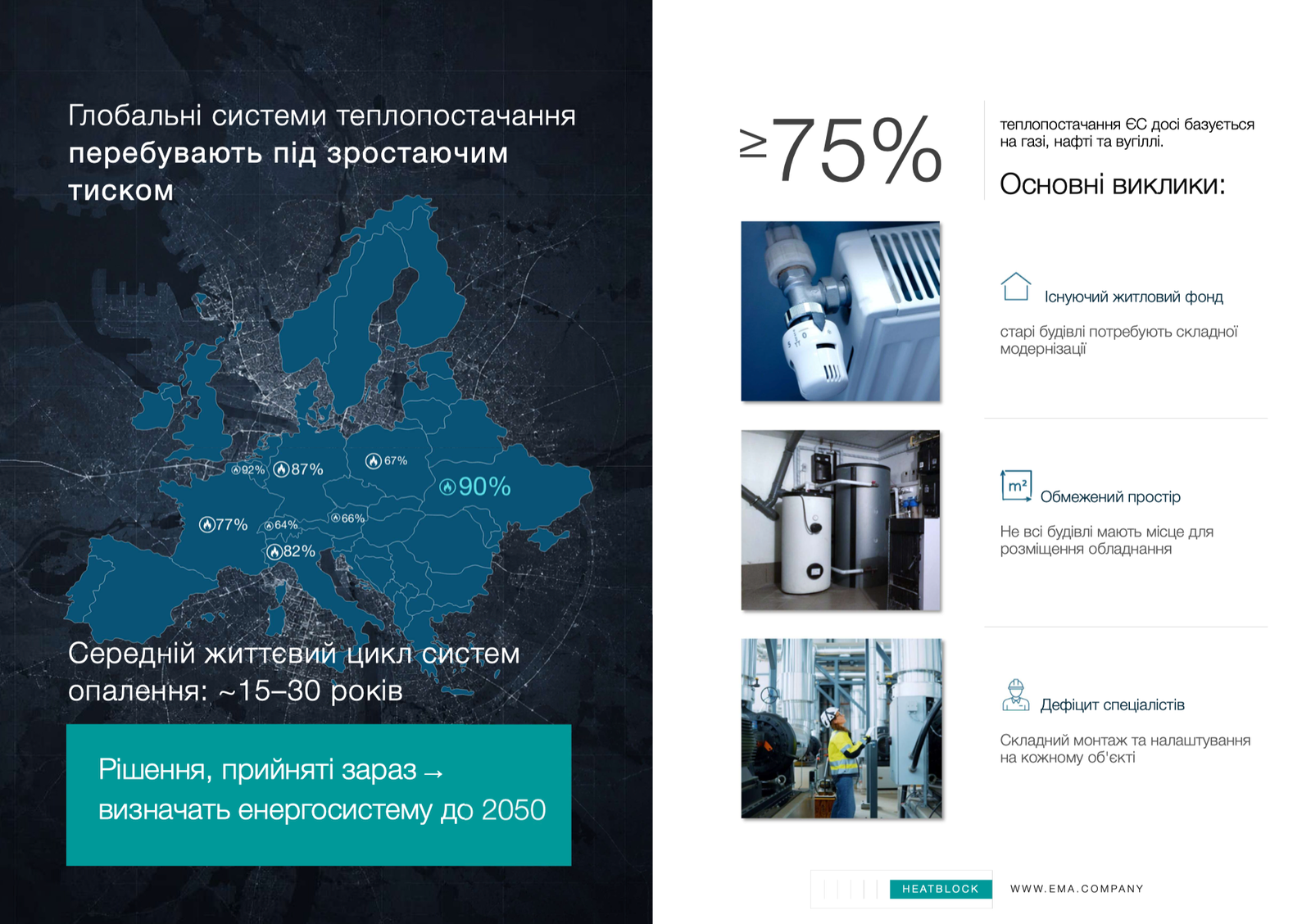
The market is transitioning to a new heating model
The energy transition for which HEATBLOCK has been developed is already measurable in statistical terms.
The share of renewables in EU electricity generation increased from 38.5% in 2020 to 47.9% in 2025. Over the same period, the share of fossil fuels declined from 36.7% to 28.8%. In 2024, renewable sources already accounted for 47.5% of electricity consumed in the EU, compared with only 15.9% in 2004.
The next major stage is the electrification of heat. Space heating accounts for 61.5% of final energy consumption in EU households, while the share of renewable energy in the heating and cooling sector increased from 11.7% in 2004 to 26.7% in 2024. Heat pump sales across 13 major European markets grew by 11% in 2025, reaching 2.34 million units. At the same time, heat pumps provide several times higher energy efficiency compared with the direct use of fossil fuels for heating.
For Ukraine, a parallel driver is the large-scale need to restore and modernize energy infrastructure. The energy sector’s recovery and reconstruction needs are estimated at $90.6 billion, and damaged assets include district heating systems.
Ukraine and the EU are moving toward a similar heating architecture from different starting points. Europe is creating demand for new thermal infrastructure. Ukraine has the opportunity not only to import this transformation, but also to become one of its manufacturing platforms.
Technical architecture of HEATBLOCK
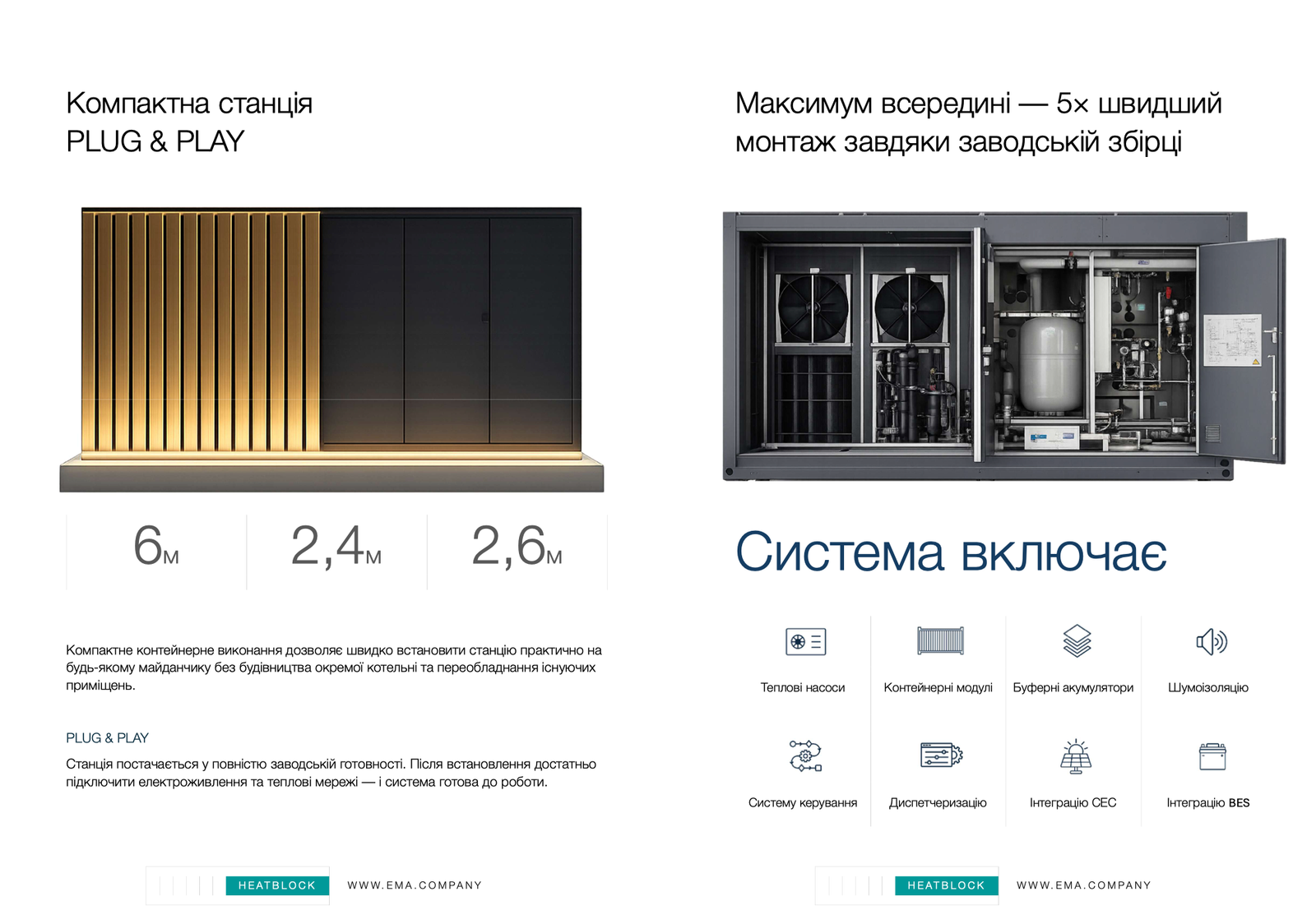
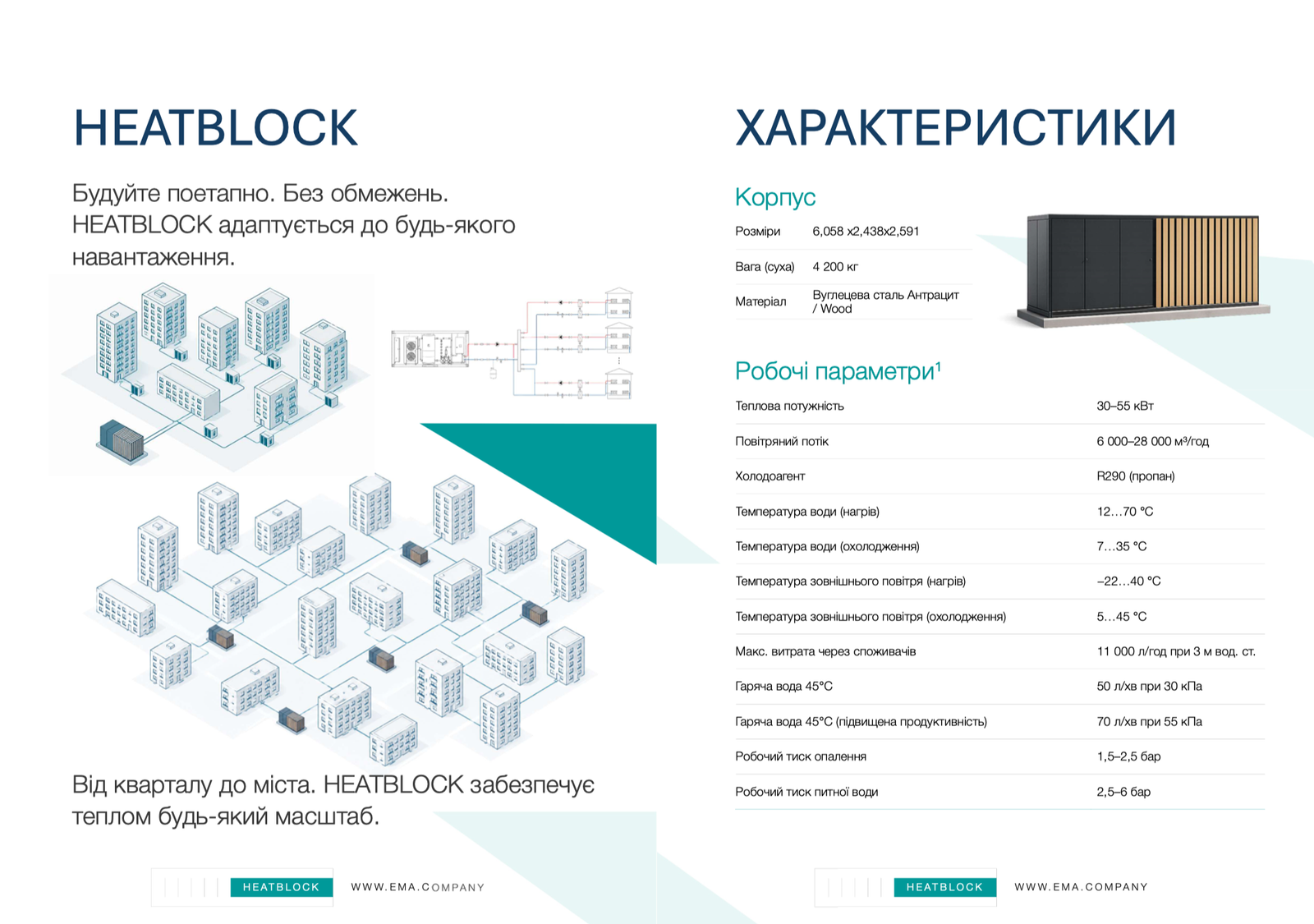
HEATBLOCK is designed in a compact Plug & Play format with a high degree of factory readiness. The base station measures 6.058 × 2.438 × 2.591 m and can be installed without constructing a separate conventional boiler house or carrying out major reconstruction of existing premises.
The technological core consists of air-source heat pumps using R290 refrigerant. The base configuration provides 30–55 kW of thermal output, a supply water temperature of up to 70°C, and heating operation at outdoor temperatures down to –22°C.
The factory-built module integrates heat pumps, hydraulic circuits, buffer storage tanks, acoustic insulation, instrumentation and control systems, automatic control, and remote dispatching. The architecture supports the integration of photovoltaic generation and BESS.
Factory assembly reduces the amount of on-site work and enables installation to be completed up to five times faster compared with conventional on-site equipment installation.
The modular architecture enables cascading capacity growth: base units form systems of 100–500 kW, while district, municipal, and industrial applications can be scaled to 1–2 MW. Capacity can be expanded in stages without changing the underlying technological platform.
End beneficiaries and application model
HEATBLOCK is designed for facilities where energy efficiency, compactness, rapid commissioning, and staged scalability are equally important.
The main beneficiaries include residential districts and new developments, territorial communities, municipal buildings, hospitals, schools and universities, industrial enterprises, industrial parks, agro-industrial facilities, and warehouses.
For new construction, HEATBLOCK enables a decentralized electrified heating system to be designed from the outset without a conventional gas boiler plant. For existing buildings, it enables heating systems to be modernized gradually by adding modules according to load requirements and the pace of reconstruction. For municipalities, this creates the opportunity to establish local heating clusters with lower dependence on large, centralized heat sources and extensive distribution networks.
Target effects for relevant system configurations include a reduction in natural gas consumption of up to 70% and decarbonization through the phase-out of fossil fuels and transition to renewable and low-carbon energy sources.
Manufacturing programme
Stage 1 — Product industrialization. A stable and repeatable manufacturing cycle is established: serial production documentation, a unified component base, FAT standards, standard connection schemes, and remote monitoring architecture. The initial portfolio consists of 5–10 reference modules for residential, municipal, commercial, and industrial facilities.
Stage 2 — Serial production and localization. The share of Ukrainian added value increases through localized container structures, hydraulic assemblies, electrical cabinets, instrumentation and control systems, programming, automation, assembly, and testing. A standardized product range of 100–500 kW systems are developed, together with a service and dispatching model and standardized PV/BESS integration solutions.
Stage 3 — Manufacturing platform scaling. HEATBLOCK expands into district, municipal, and industrial systems with cascaded capacities of up to 1–2 MW. Certification, partner networks, and service infrastructure establish the foundation for a systematic presence in EU markets.
Key performance indicators include the number of modules produced, the share of localized added value, manufacturing lead time, actual COP/SCOP performance, installed cost per kW of thermal capacity, reduction in natural gas consumption, and operating costs.
Investment and partnership model
HEATBLOCK is being developed as a scalable manufacturing and engineering platform for the decentralized thermal infrastructure market.
The estimated investment requirement is €8.5–15 million. Investments are directed toward manufacturing capacity, engineering/R&D, automation, initial reference installations, certification, localization, service and digital infrastructure, and preparation for scaling in EU markets.
The partnership model is structured as industrial cooperation.
International technology manufacturers supply heat pumps, BESS, automation systems, and other specialized components. E.M.A. provides system engineering, localization, manufacturing, integration, FAT, commissioning, and service.
Municipalities, developers, and industrial consumers form the real-world application portfolio.
Donor institutions support decarbonization, reconstruction, energy efficiency, and technology transfer, while strategic and financial investors participate in scaling the product across the Ukrainian and EU markets. The financial model targets an IRR of 18–24%, an EBITDA margin of 18–30%, a discounted payback period of 5–7 years, and potential annual revenue of €12–25 million after scaling.
Manufacturing the energy infrastructure of the future
HEATBLOCK establishes a model for producing next-generation thermal infrastructure: serially, locally, modularly, and with a high degree of factory readiness.
Europe’s energy transition is creating structural demand for the electrification of heat. At the same time, Ukraine’s reconstruction is generating large-scale demand for new, more distributed and resilient energy infrastructure.
At the intersection of these processes, Ukraine has the opportunity to develop its own manufacturing role in the European energy transition.
HEATBLOCK combines international heat pump technologies with Ukrainian engineering, localization, and serial manufacturing, creating an industrial platform for decentralized thermal infrastructure for the Ukrainian and EU markets.