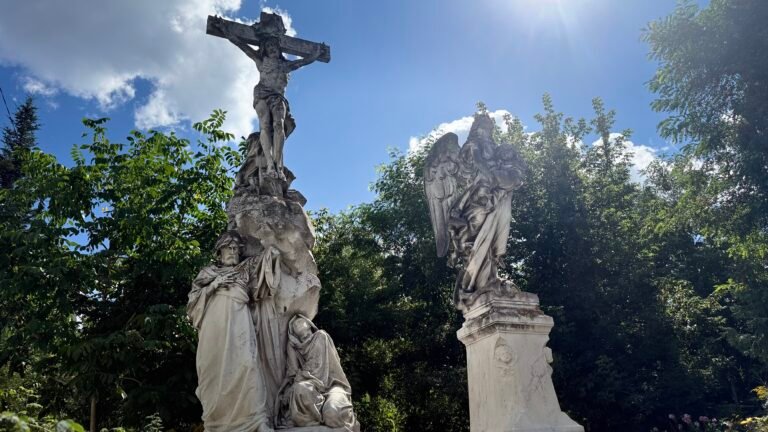
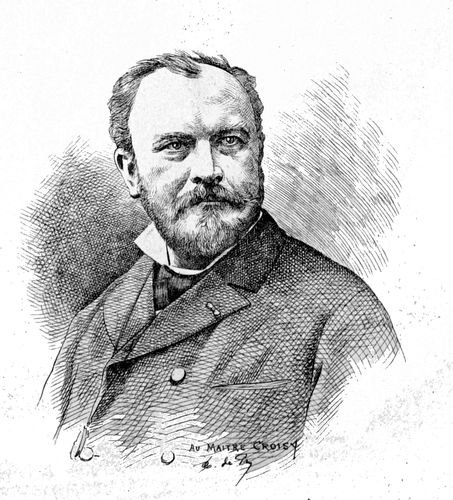
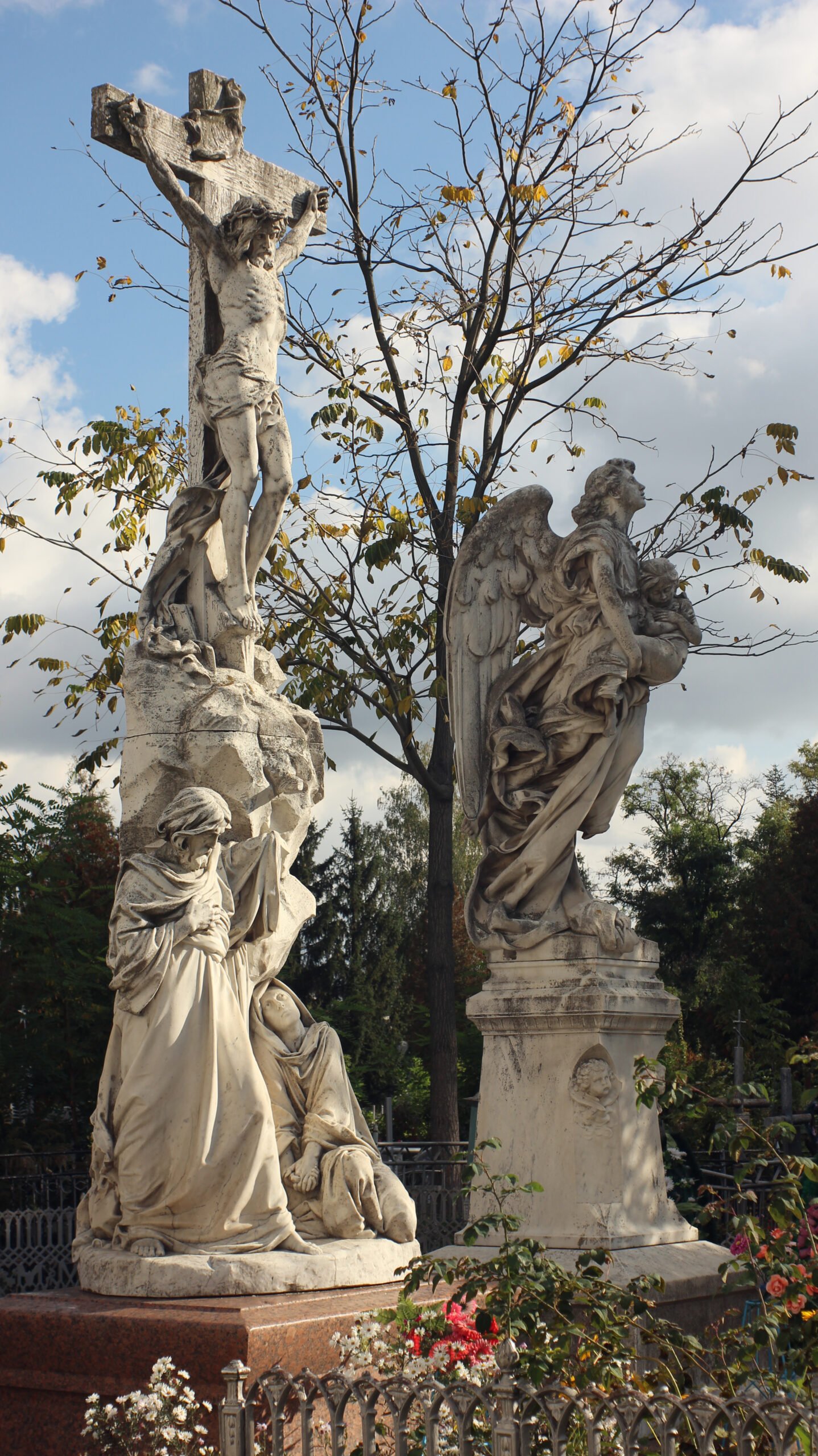
The Croisy (Aristide Croisy) statues in Sumy, Ukraine, are the late-19th-century white Italian marble funerary sculptures at the Kharytonenko family burial site in Petropavlivske (Central) Cemetery, near the Saints Peter and Paul Church.
They consist primarily of:
“Two Angels” / “Angel with a Child” (1891): An angel with outstretched wings carrying the deceased young Zinaida Kharytonenko (granddaughter of industrialist/philanthropist Ivan Kharytonenko, who died at age 8 from diphtheria). The girl’s face was based on a photograph sent to the sculptor; the work was exhibited at the Paris Salon before installation.
“Golgotha” / “Calvaire” (c. 1894): A Calvary group for Ivan Kharytonenko’s grave, including related figures (Croisy also produced related elements such as a moujik/peasant with Ukrainian children for the family complex).
Both are national cultural heritage monuments of Ukraine (listed in the State Register). They are among the finest surviving works by the French sculptor Aristide Onésime Croisy (1840–1899) outside France.
Current condition
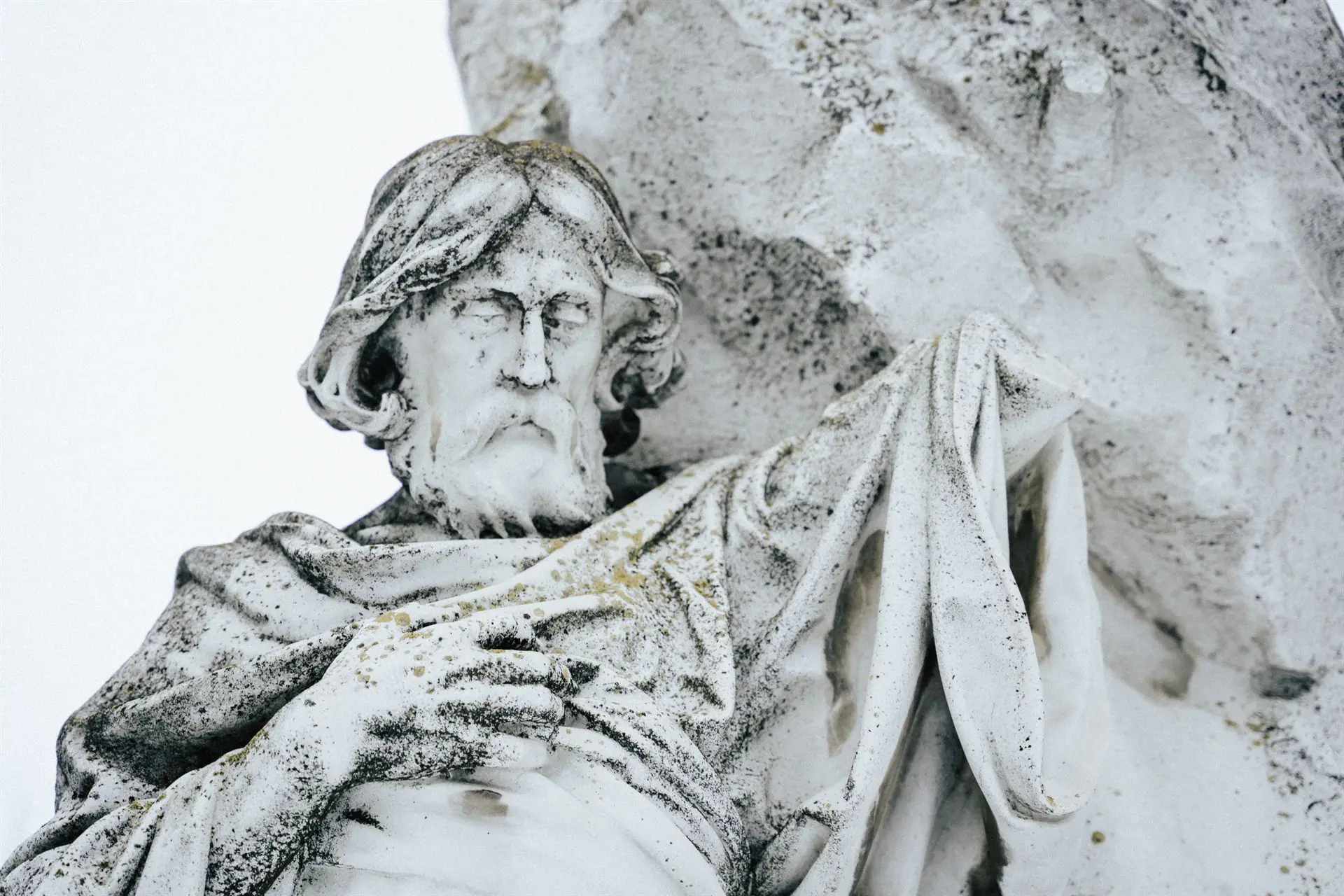
The statues have deteriorated from long outdoor exposure (sun, rain, vegetation growth, cracks). On “Golgotha,” the figure of the Apostle John has lost a marble arm. They remain at risk from the ongoing war (Sumy is near the Russian border and subject to shelling). Temporary protective measures have included wrapping in reinforced fabric/agro-fiber and surrounding with sandbags. Full physical restoration has been discussed and partially planned for years (including offers of materials and expertise from Italian specialists around 2020–2021 and municipal/Ministry of Culture obligations), but comprehensive work has not been completed.
In the sculpture “Golgotha”, the Apostle John does not have a left hand. Photo: Cukr Media
These monuments are on the balance sheet of the Department of Infrastructure of the Sumy City Council, explains Yuriy Gladenko, head of the Department of Culture, Tourism and Religions of the Sumy City Administrative Organization. The condition of the sculptures is currently unsatisfactory, this was recorded in special acts in 2021 and 2023.
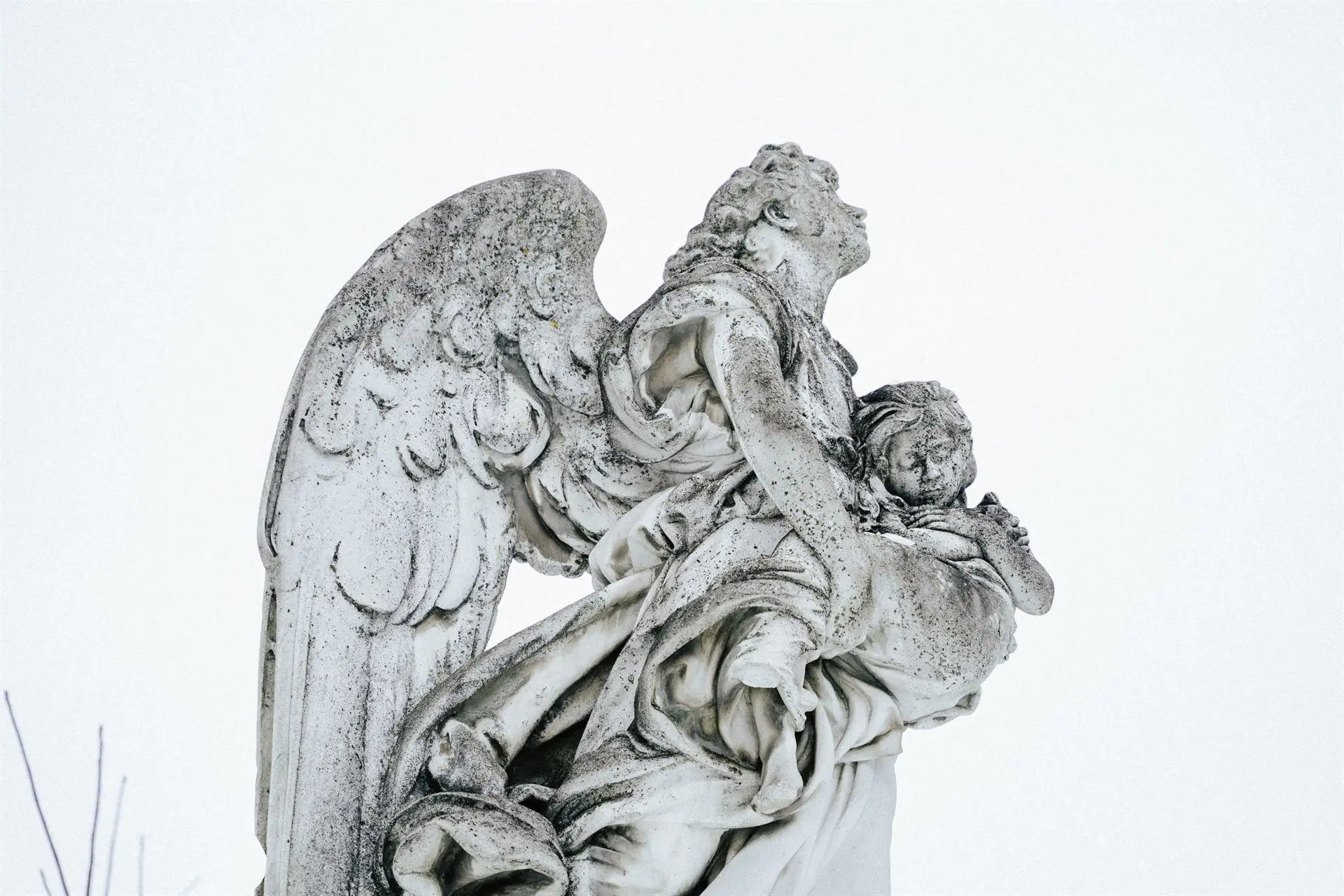
Sculpture “Angel with Child”. Photo: Cukr Media
This sculpture depicts an angel taking a girl with her arms crossed to heaven. The sculpture is 2.5 meters high, and its pedestal is 2.3. It was installed in Sumy in 1891, during the lifetime of Zinaida’s grandfather, Ivan Kharytonenko.
In November 1891, Ivan Gerasymovich died, so the family began to think about the pedestal. His first sketch, which depicts a group composition of Ivan Gerasymovich Kharitonenko with children, is preserved in Le musée de l’Ardenne in France.
At first, they chose this idea to emphasize Ivan Kharitonenko’s philanthropic activities. After all, at one time he took good care of the establishment of educational institutions. But when his grandson Hlib died, and this was not earlier than 1897, the family abandoned the first sketch. Instead, they chose the current version of the sculpture “Golgotha.
It was installed on the family grave between 1897 and 1899. The height of the sculpture is 3.5 meters, and its pedestal is 2.5.
How reconstruction could be approached
Reconstruction (or more precisely, conservation + restoration, with the option of full reconstruction if severely damaged or destroyed) follows standard professional cultural-heritage practice for outdoor marble sculpture, adapted to wartime conditions in Ukraine.
Key steps, based on documented local efforts and general best practices for such monuments, are:
Documentation and digital recording (already underway and foundational) High-resolution photogrammetry and 3D scanning create accurate digital twins that capture the current form, surface texture, damages, and missing elements. Local architects (e.g., teams associated with SM Architects / Ihor Tytarenko and related scientific projects on virtual reconstruction of Ukrainian heritage) have produced such models from hundreds of photographs. These serve as the primary reference for any future physical work, allow virtual reconstruction/visualization, support international fundraising or presentation, and enable physical replication (e.g., via CNC milling or 3D-printed molds for replacement parts) if the originals are further damaged or lost.
Condition assessment and scientific analysis Conservators examine the marble (type, porosity, existing cracks, biological growth, previous repairs), structural stability of figures and pedestals, and environmental factors. Laboratory analysis of samples may guide cleaning agents and consolidants. Missing elements (such as the arm) are studied via historical photos, plaster models/maquettes by Croisy (some of which were shown at Paris Salons), and the new 3D data.
Stabilization and protection Immediate measures: temporary sheltering or framing (wooden/metal supports or protective covers have been recommended by local cultural authorities), removal of vegetation, gentle cleaning of surface dirt and biological growth with appropriate non-abrasive methods and materials suitable for Italian marble, and structural consolidation of cracks or weak areas to prevent further loss.
Cleaning and conservation treatment Controlled cleaning (often starting with materials previously offered by Italian specialists), desalination if needed, consolidation of friable marble, and filling of cracks with compatible materials (marble dust + resins or traditional lime-based mortars matched to the original). Any intervention aims for reversibility and minimal aesthetic change.
Restoration or reconstruction of missing parts Lost elements (e.g., the arm) can be recreated by skilled marble sculptors/carvers using the 3D models, historical references, and matching Italian marble. Techniques may include traditional hand-carving or digital fabrication (milling a blank from the scan data, followed by hand-finishing). The goal is usually to restore visual and structural integrity while clearly distinguishing new work if required by conservation ethics (or fully integrating it for funerary monuments of this type). Protective coatings or improved drainage/shelter may be added to slow future weathering.
Installation, monitoring, and long-term care Reassembly or re-securing on the original pedestals/site (or, in extreme cases of ongoing threat, possible relocation to a protected indoor or semi-protected setting, though in-situ preservation is preferred for cemetery monuments). Ongoing monitoring, periodic maintenance, and possible glass or architectural canopy protection have been suggested by local experts. Official permissions from the Ministry of Culture and local authorities, plus specialized conservators (potentially international collaboration), are required because of the national-monument status.
Physical work requires specialized marble conservators, funding, and secure conditions. Digital models already provide a robust backup and practical foundation for any reconstruction. Local initiatives continue to prioritize these sculptures as important cultural assets linked to Sumy’s history of philanthropy and European artistic connections.